
FWSC Moves to Link Pay to Productivity as National Roundtable Conference Committee Is Inaugurated
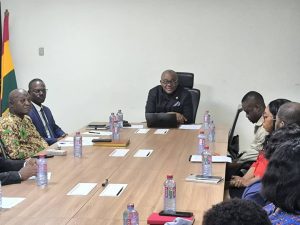
The Fair Wages and Salaries Commission has begun a major shift from a pay-driven system to a productivity-driven compensation model, with the inauguration of a committee to organise a National Productivity Roundtable Conference.
The seven-member committee has representation from the Public Services Commission, State Interest and Governance Authority (SIGA), Management Development and Productivity Institute (MDPI), and Fair Wages and Salaries Commission (FWSC).
Before inaugurating the committee in Accra on Thursday, April 16, 2026, the Chief Executive of the FWSC, Dr. George Smith-Graham, said the current wage model is “no longer sustainable, fiscally, economically, or socially.”
“For far too long, compensation discussions in our country have been dominated by negotiations around wages, often disconnected from measurable productivity outcomes,” the chief executive told committee members.
The move ties into broader public sector reforms. Dr. Smith-Graham warned against introducing a new pay policy that “simply pays people more for doing the same old job.” He called for a full review of schemes of service, describing many as “completely outdated” with the advent of AI.
High Cost, Low Wages
The director of productivity and performance-based rewards at the FWSC, Cephas Amada, revealed that more than 40% of Ghana’s non-tax, non-oil revenue is spent on compensation, a figure higher than the African benchmark. Yet the minimum wage stands at $1.98, below the global poverty line of $2.15.
“This suggests either our recruitments are not properly tailored to our needs, or our productivity levels are generally low,” he said. “A country that turns its attention away from productivity invariably embraces poverty.”
National Roundtable to Drive Reform
The National Productivity Roundtable is not just another conference. It is designed as a strategic national intervention to reframe the conversation on pay, build consensus on productivity measurement, and lay the foundation for a performance and productivity-linked pay system.
Four Key Mandates for Committee
The committee has been tasked with key expectations, including ensuring the conference is outcome-oriented with clear, actionable recommendations to feed into the National Productivity Framework and a new Performance-Based Pay Policy.
Recent Comments